items:
$0.00
items:
$0.00


- It’s the FUN way for children to learn another language with music, activities, games, drama, arts & crafts. Join the club at your school.Ask us about starting a Fun Languages club at YOUR child’s school in 2018!
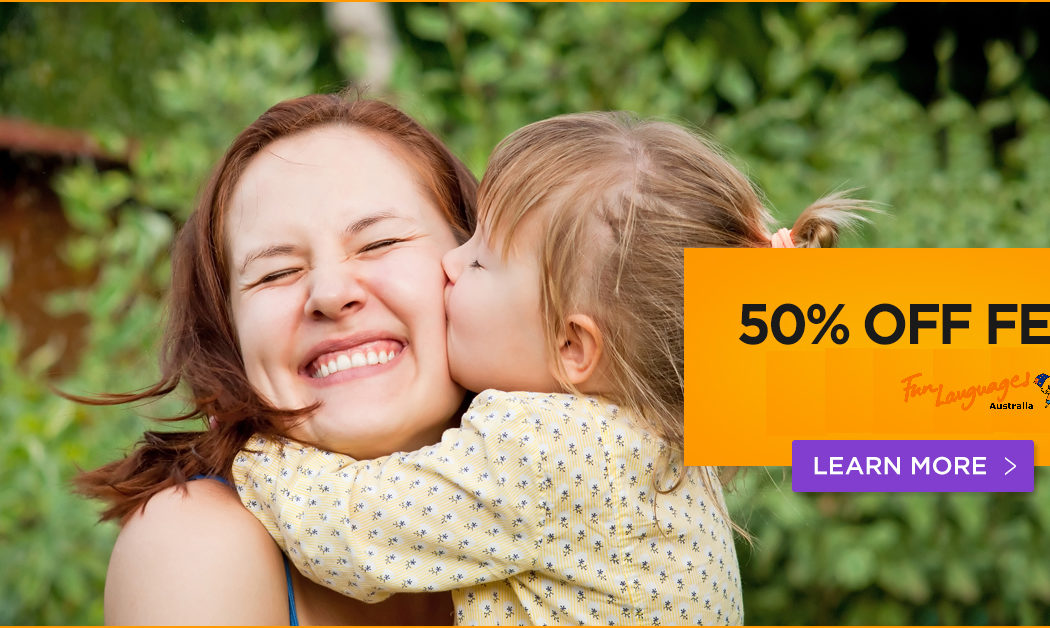
*HALF PRICE SALE. Low as $63 per term! Use code QWER50 get 50% OFF.
*50% off only applies to the following clubs. 50% OFF is available to new students for term 1 2018 only
Sydney, NSW

Spanish on Thursdays 5-12 yrs at Rainbow Street Public School Was $
246Now only $123Spanish on Thursdays 5-12 yrs at Bourke Street Public School Was $
246Now only $123Spanish on Mondays 5-12 years at Bondi Beach Public School Was $
246Now only $123Spanish on Fridays 5-12 years at St. Brigid’s Primary School Was $126 Now only $63

Mandarin on Fridays 5-12 years at Lane Cove Public School Was $
246Now only $123Mandarin on Wednesdays 5-12 years at St. Margaret Mary’s Catholic School Was $18
6Now only $93Mandarin on Tuesdays 5-12 yrs at Bondi Beach Public School Was $
246Now only $123Mandarin on Fridays 5-12 years at St. Aidan’s School Was $
210Now only $105
Italian on Wednesdays 5-12 yrs at Bondi Beach Public School Was $
246Now only $123Italian on Thursdays 5-12 yrs at Brigid’s Primary School Was $1
26Now only $63Italian on Tuesdays 5-12 yrs at St. Aidan’s School Was $
210Now only $105Italian on Mondays 5-12 yrs at Margaret Mary’s Catholic school Was $186 Now only $93

German on Thursdays 5-12 yrs at Stanmore Public school Was $
246Now only $123
French on Mondays 5-12 years at Lane Cove Public School Was $
246Now only $123French on Tuesdays 5-12 yrs at Summer Hill Church Was $
246Now only $123French on Tuesdays 5-12 yrs at Camdenville Public School Was $
246Now only $123French on Thursdays 5-12 yrs at Pius Catholic School Was $
246Now only $123French on Thursdays 5-12 yrs at Maroubra Junction Public School (AM) Was $
246Now only $123French on Thursdays 5-12 yrs at Lane Cove West Public School Was $
246Now only $123French on Mondays 5-12 yrs at Stanmore Public School Was $
246Now only $123French on Mondays 5-12 yrs at Stanmore Public School (Advanced) Was $
246Now only $123French on Mondays 5-12 yrs at St. Aidan’s Catholic Primary School Was $
210Now only $105French on Mondays 5-12 yrs South Coogee Public School Was $
246Now only $123French on Fridays 5-12 yrs at Malabar Public School Was $
246Now only $123Newcastle, NSW
French on Tuesdays 5-12yrs at New Lambton Public School Was $144 Now only $72
French on Tuesday 5-12yrs at St Aloysius PS Was $135 Now only $67.5
French on Wednesday 5-12 yrs at New Lambton Public School Was $144 Now only $72
German on Friday 5-12 yrs at Bel Air Public School Was $144 Now only $72
Melbourne, VIC
French on Mondays 5-12 yrs at Alphington Primary School Was $186 Now only $93
French on Mondays 5-12 yrs at Blackburn Primary Was $198 Now only $99
French on Tuesdays 5-12 yrs at Ivanhoe East Primary School Was $
220Now only $110French on Wednesday 5-12 yrs at Kensington Public School Was $
220Now only $110French on Thursday afternoon at Ivanhoe Primary School Was $
230Now only $115French on Tuesdays 2-5 yrs at Language International Bookshop Was $180 Now only $90
French on Thursdays 2-5 yrs at Livingstone Community Centre Was $180 Now only $90
French on Thursdays 5-12yrs Princes Hill, Melbourne, VIC Was $230 Now only $115
French on Wednesdays 5-12yrs, Brunswick North West, Melbourne Was $220 Now only $110
-
-
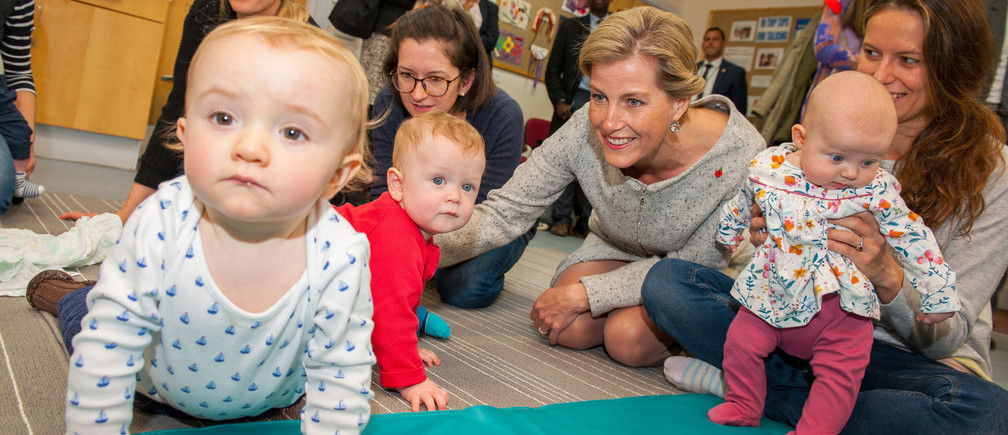
 I-LABS researchers have found that it is possible to give very young children the opportunity to start learning a second language.Image: REUTERS/Dominic LipinskiThis article is a copy of what was published in Futurity on 24 Jul 2017Researchers have developed a play-based educational program that can teach babies a second language in just one hour per day.
For years, scientists and parents alike have touted the benefits of introducing babies to two languages: Bilingual experience has been shown to improve cognitive abilities, especially problem-solving.
And for infants raised in households where two languages are spoken, that bilingual learning happens almost effortlessly. But how can babies in monolingual households develop such skills?
“As researchers studying early language development, we often hear from parents who are eager to provide their child with an opportunity to learn another language, but can’t afford a nanny from a foreign country and don’t speak a foreign language themselves,” says Naja Ferjan Ramirez, a research scientist at the University of Washington Institute of Learning & Brain Sciences (I-LABS).
A new study by I-LABS researchers, which appears in the journal Mind, Brain, and Education, is among the first to investigate how babies can learn a second language outside of the home.
The researchers sought to answer a fundamental question: Can babies be taught a second language if they don’t get foreign language exposure at home, and if so, what kind of foreign language exposure, and how much, is needed to spark that learning?
The researchers took their query all the way to Europe, developing a play-based, intensive, English-language method and curriculum and implementing it in four public infant-education centers in Madrid, Spain.
Teaching with ‘parentese’
Sixteen undergraduates and recent graduates served as tutors for the study, undergoing two weeks of training at I-LABS to learn the teaching method and curriculum before traveling to Spain. The country’s extensive public education system enabled the researchers to enroll 280 infants and children from families of varying income levels.
Based on years of I-LABS research on infant brain and language development, the method emphasizes social interaction, play, and high quality and quantity of language from the teachers. The approach uses “infant-directed speech”—often called “parentese”—the speech style parents use to talk to their babies, which has simpler grammar, higher and exaggerated pitch, and drawn-out vowels.
“Our research shows that parentese helps babies learn language,” Ferjan Ramirez says.
Babies aged 7 to 33.5 months were given one hour of English sessions a day for 18 weeks, while a control group received the Madrid schools’ standard bilingual program. Both groups of children were tested in Spanish and English at the start and end of the 18 weeks.
Have you read?
“Science indicates that babies’ brains are the best learning machines ever created…”
The children also wore special vests outfitted with lightweight recorders that recorded their English learning. The recordings were analyzed to determine how many English words and phrases each child spoke.
The children who received the new method showed rapid increases in English comprehension and production, and significantly outperformed the control group peers at all ages on all tests of English.
By the end of the 18-week program, the children in the researchers’ program produced an average of 74 English words or phrases per child, per hour; children in the control group produced 13 English words or phrases per child, per hour.
Ferjan Ramirez says the findings show that even babies from monolingual homes can develop bilingual abilities at this early age.
“With the right science-based approach that combines the features known to grow children’s language, it is possible to give very young children the opportunity to start learning a second language, with only one hour of play per day in an early education setting,” she says. “This has big implications for how we think about foreign-language learning.”
‘The best learning machines’
Follow-up testing 18 weeks later showed the children had retained what they learned. The English gains were similar between children attending the two schools serving predominantly low-income neighborhoods and the two serving mid-income areas, suggesting that wealth was not a significant factor in the infants’ ability to learn a foreign language.
Children’s native language (Spanish) continued to grow as they were learning English, and was not negatively affected by introducing a second language.
 Image: South China Morning Post
“Science indicates that babies’ brains are the best learning machines ever created, and that infants’ learning is time-sensitive. Their brains will never be better at learning a second language than they are between 0 and 3 years of age,” says coauthor Patricia Kuhl, codirector of I-LABS and a professor of speech and hearing sciences.
The results, Kuhl says, have the potential to transform how early language instruction is approached in the United States and worldwide:
“Parents in Madrid, in the United States, and around the world are eager to provide their children with an opportunity to learn a foreign language early. The US census shows that 27 percent of America’s children under the age of 6 are now learning a language other than English at home.
“While these children are fully capable of learning both their parents’ language and English, they often do not have adequate exposure to English prior to kindergarten entry and as a result, often lag behind their peers once they enter school,” she says.
“I-LABS’ new work shows we can create an early bilingual learning environment for dual-language learners in an educational setting, and in one hour per day, infants can ignite the learning of a second language earlier and much easier than we previously thought. This is doable for everybody,” Kuhl says.
-
-
Fun Base Learning is one of the best methodology for teaching languages. It is best for learning and delivers amassing results. Fun Base Learning is suitable for children aged between 5 and 12 years and in primary schools, as well as those aged 0-5 years and in childcare centers.
The idea behind Fun Base Language Learning is making learning a fun-filled activity for all children. The little ones learn better when their lessons are filled with plenty of fun. This way, it is easier for their minds to retain new learning.
Languages Taught
Fun Base Learning approach has proved highly effective at teaching the following languages at LCF Fun Languages Australia:
- French
- Spanish
- Mandarin
- Italian
- German
More importantly, the classes at LCF Fun Languages Australia do not revolve around languages alone. On their own, languages may not be fun to learn. The methodology used in making languages fun to learn features several activities that include games, technology, dance, music and songs, activity sheets, drama and role playing.
Small Group Learning
Each teacher takes care of a small group of learners. This ensures that all students receive the personal attention required to learn a new language successfully. The approach works well regardless of the student’s familiarity (or lack thereof) with the new language.
The methodology takes cognizant of the natural process that is involved in acquiring or learning a new language, especially among little children. This method trains children to excel in not only listening, but also repeating, speaking, reading and writing the newly acquired language.
Encourages Independent Learning
The fun-based approach allows children to develop into independent learners. It directs them towards learning by making inquiries too. The fact that children naturally love to explore and possess highly inquisitive minds helps make the entire approach quite successful.
Children who show up for the fun-based learning may already have a first language. The program uses this as the basis for teaching them a second language. It does not ignore the similarities and differences that exist between the children’s first and second languages.
The driving guide of the entire program is communication. This is closely related to inter-cultural understanding that the program endeavors to transmit to the young minds. At the end of the program, each student becomes a good communicator and understands other cultures well.
Therefore, the premise is that Fun Base Language Learning is not only best for learning, but also the perfect approach for delivering great results. It benefits children in several ways by allowing them to learn in fun-filled surroundings.
Contact us to start a language program at your primary school or childcare centre. www.lcfclubs.com.au or 1300 707 288
LCF Fun Languages Australia Media Team
(*LCF Fun Languages Australia, operates pre-school, childcare centre, kinder, Montessori, before and after-school language learning centres across Australia. Operating throughout Europe, Australasia, South America and Asia, LCF started teaching languages in 1985 with a method based on the natural way that children acquire a language.)
-

-
-
LCF Fun language services (French, Spanish, Mandarin, Italian & German Language and Jazz-Mataz music & movement program) can give your childcare centre a competitive ADVANTAGE!
-
-
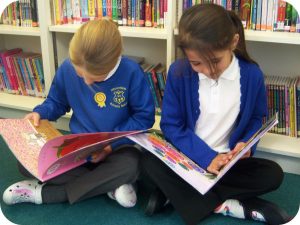
3 ways to keep your little linguist motivated
Motivation is one of the key success factors in language learning. If your little language learner doesn’t see any reason in why learning or speaking the target language could be useful or fun for him or her, they will quickly do exactly the opposite – which is not use it at all.
Here are our top 3 tips in how to boost motivation in language learning.
#1 Travel
What can be better than hitting the road with mom and dad, seeing exciting places, eating delicious local food and experiencing a whole new world?
Being immersed to an environment where target language is the most commonly used is one of the most efficient ways to give language learning motivation a boost. This way you give your child not only the opportunity to hear, speak and interact but also the chance to learn about traditions, food, history and culture of the country.
#2 Make friends
Nothing is better than learning and laughing with a buddy – for you and for your little linguist. Join a hobby group, build a support network and make friends with other families, who are raising their kids with the same languages. This way you ensure interaction in the target language in a relaxed and safe environment with same-aged kids, which is one of the most crucial factors in language learning motivation.
#3 Fun
Using the language should be fun – think of activities in the language which makes your child want to speak it. This could be movies, books, games, role plays, dancing, songs, theaters and other fun activities. Joining one of our LCF Fun Languages Clubs will also make languages a fun social event for your child. LCF language clubs are based on a play-based immersion learning and our curriculum responds to children, their interests, hobbies and preferences.
If you would like to find out more about our methodology, please click here.
-